The Influence of Street Art on High-End Gallery Exhibitions
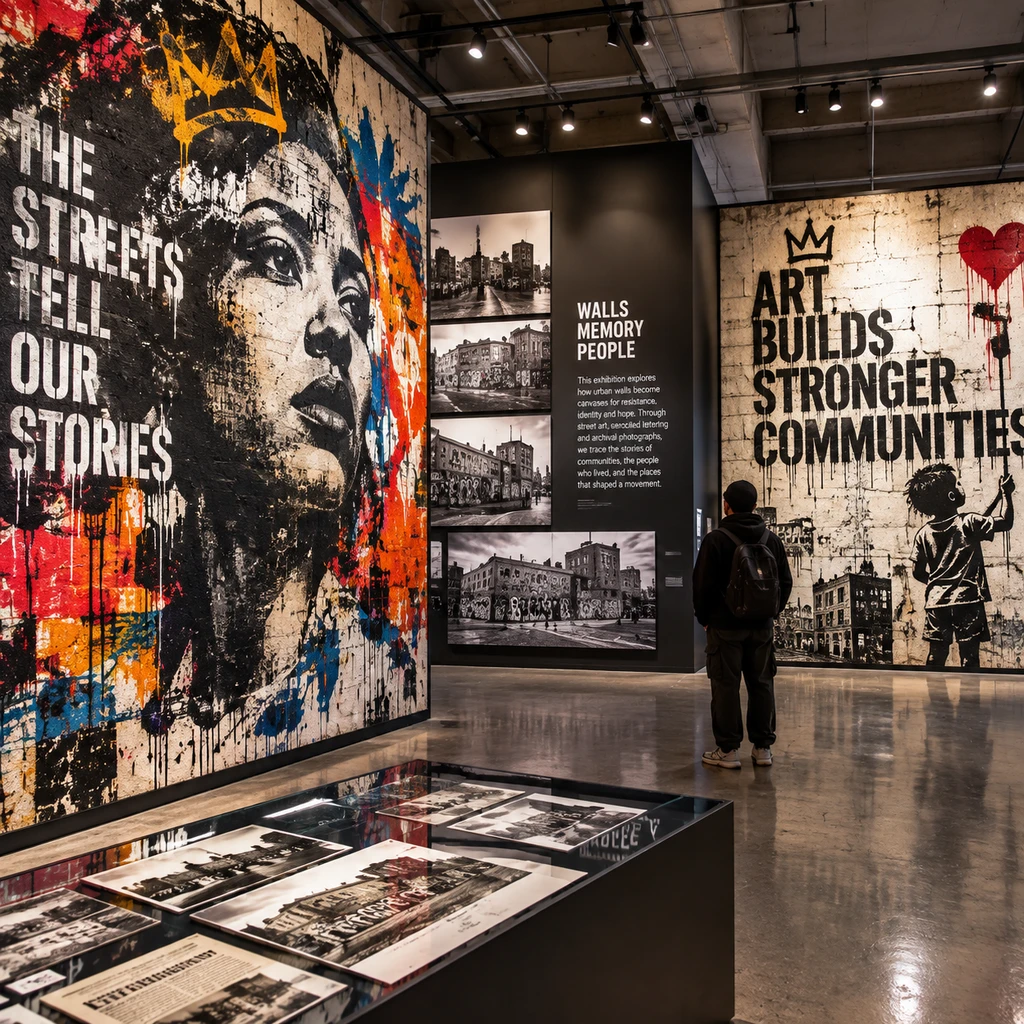
Street art has changed what contemporary art galleries exhibit and how they invite people to look. Murals, graffiti, stencils, wheatpaste posters, and other forms born in public space bring the scale and urgency of the street into carefully designed rooms. The transition can give artists new audiences and preserve work that might otherwise disappear. It can also alter the meaning of the work, especially when an image created for an open city wall becomes a collectible object.
That tension is central to the influence of street art on high-end gallery exhibitions. The most thoughtful shows make room for both the visual impact and the original context: who could encounter the work, where it appeared, and what its presence meant.
From Public Walls to Gallery Spaces
Street art enters gallery spaces when artists, curators, or communities translate work made for public settings into an exhibition format. That move can preserve fragile images and expand their audience, but it changes who encounters the work and under what conditions.
On a city wall, viewers may discover a mural on the way to work, see it from a passing bus, or return to it as the neighborhood changes. The work shares space with traffic, architecture, weather, advertising, and local life. In a gallery, visitors usually choose to attend, follow a route through the exhibition, and view the work under controlled lighting. Location is part of the artwork’s meaning, not just its backdrop.
Galleries present street art in several ways. They may show photographs and documentation of public projects, exhibit portable works on canvas or paper, or commission an artist to create a mural directly on gallery walls. These approaches are not interchangeable. A photograph records a specific encounter; a studio work may use the same visual language without being public art; a commissioned mural brings the act of painting indoors but cannot reproduce the street’s open access.
Curators can help bridge the gap with maps, installation views, dates, and accounts of the places where works appeared. That context matters most when a piece responds to a particular community or site. Removing it without explanation risks turning a situated gesture into a purely decorative image.
The Visual Language Street Art Brings to Contemporary Art
Street art brings bold scale, lettering, repetition, and urban imagery into contemporary art exhibitions. These features change how visitors move through a gallery and how they read its walls.
A large mural can interrupt the familiar rhythm of framed works. It may fill a room, wrap around a corner, or meet viewers at eye level, making the body part of the viewing experience. Artists also draw on graffiti’s lettering and tags, stencil techniques, repeated symbols, and the layered surfaces of the city. The result can feel immediate even when the work has been carefully composed.
Urban imagery carries its own associations. A painted-over poster, a brick texture, or a handstyle can suggest visibility, protest, ownership, or impermanence. In an exhibition, those references meet gallery conventions: labels, barriers, lighting, and a presumed art audience. The contrast can sharpen a work’s message, but it can also smooth away rough edges if the display treats every mark as a style choice detached from its social setting.
Scale and repetition are especially powerful in gallery design. Repeated motifs may lead the eye across a wall, while a monumental image can make a polished white room feel less neutral. Muralism, meanwhile, connects street practice with a longer history of public-facing wall painting. It gives curators a way to discuss how artists use shared surfaces to tell stories, claim visibility, or respond to civic life.
Curating the Street-to-Gallery Transition
Curatorial practice shapes whether a gallery exhibition preserves street art’s context or recasts it as an isolated object. Strong exhibition design connects the work to its site, audience, and method of production.
A curator might pair a mural with photographs of its original location, sketches, material samples, or a short account of how the artist worked with local residents. A timeline can show whether a piece was temporary, commissioned, or painted without permission. Such details help visitors distinguish between works that share visual traits but differ in purpose and circumstance.
Installation choices matter, too. A mural reproduction displayed behind a barrier may look monumental yet feel inaccessible. A floor-to-ceiling commission can create a more immersive encounter, although the gallery still controls the space and its opening hours. Clear labels should identify whether a work was made for the exhibition, relocated from a public site, or documented after the fact. That distinction is basic, but it is often the difference between informed interpretation and a misleading impression.
Curators should also consider what is absent. A wall painting may have been created in a neighborhood facing redevelopment; a public artwork may have been removed, painted over, or contested. The exhibition need not resolve those disputes, but it should avoid implying that gallery display tells the whole story. Context is part of the exhibition design, not an optional add-on.
Authenticity, Access, and Institutional Recognition
Institutional recognition can increase an artist’s visibility, but it does not automatically validate street art or preserve its original meaning. The central tension is between public access and the gallery’s power to select, frame, and control what audiences see.
Street art is often associated with independence because it appears beyond traditional exhibition systems. Yet the category includes many practices, from authorized muralism to unsanctioned graffiti, and artists may move between public commissions, studios, and galleries. There is no single test of authenticity based on location alone. The more useful questions are who made the work, for whom, under what conditions, and with what relationship to its site.
When a gallery exhibits work connected to a neighborhood, it should be clear about permissions, collaborators, and the circumstances of removal or reproduction. Consultation with local participants can improve interpretation, though it cannot guarantee that every community member agrees with the exhibition. A gallery also needs to explain the limits of what it can represent: a photograph of a wall is evidence of a public encounter, not a substitute for the wall itself.
Access has practical and symbolic dimensions. A gallery can offer shelter from weather and preserve delicate work, but admission policies, location, and opening hours may limit who can see it. Recognition and accessibility are separate outcomes. A show can be prestigious while remaining difficult for the original audience to reach.
Artists, Collectors, and the Changing Art Market
Gallery exhibitions can broaden an artist’s audience and create new opportunities for art collecting, while also changing how street-associated work is valued. The market may reward portable objects more readily than site-specific projects that resist ownership.
Collectors often encounter artists through paintings, prints, photographs, or editions shown in galleries. Sales can support an artist’s practice and help fund future projects. At the same time, a canvas made for sale is not automatically equivalent to an artwork encountered in public space. Its relationship to graffiti, muralism, or a particular neighborhood may be a reference rather than a direct continuation of that work.
Artists have agency in deciding how to enter gallery settings. Some create new work for the exhibition; others document projects that have since changed or disappeared. A responsible exhibition makes those choices legible instead of presenting every object as a fragment of a street scene. Collectors, in turn, can ask about provenance, edition details, site history, and whether a work was created specifically for sale.
For galleries, the challenge is to present marketable objects without reducing an artist’s practice to an easily recognized visual formula. A successful show may lead viewers toward less familiar parts of an artist’s work, including community collaborations, public commissions, or experiments that do not translate neatly into a private collection.
What Audiences Gain from Seeing Street Art in a Gallery
Gallery exhibitions let audiences study street art at close range and encounter it alongside historical or curatorial context. They also raise questions about who can access the work once it leaves public space.
In a gallery, visitors can notice paint layers, paper edges, corrections, and details that are easy to miss on a high wall or from a moving vehicle. Curatorial texts and archival material can explain a work’s development, neighborhood setting, or political moment. For viewers unfamiliar with graffiti and street art, that information offers a route into the work without assuming that all public painting has the same history or intention.
There is a trade-off. A gallery visit is deliberate, while street encounters can be accidental and shared by people who never enter an art institution. Seeing a mural indoors may deepen attention, but it cannot recreate the original site, its neighbors, or the possibility that the artwork will change or disappear. If you visit a street-art exhibition, look for the work’s date and location, how it was made or documented, and what the gallery says about its relationship to the public.
The best exhibitions leave viewers with more than an image to admire. They make the change in setting visible and invite audiences to consider how place, audience, and institutional recognition shape what counts as art. That approach respects the gallery’s ability to preserve and interpret while keeping the work’s public origins in view.